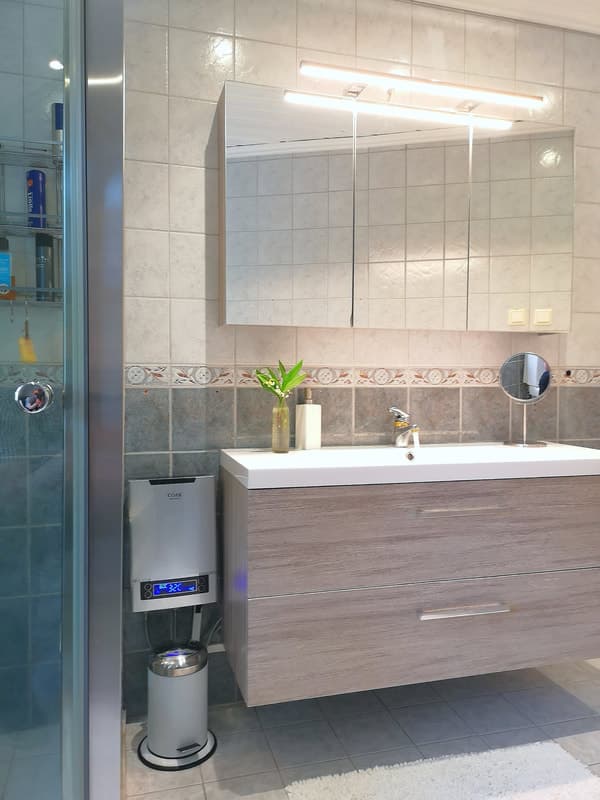
Water heater for homes and flats
Before replacing a conventional water heater, check the power supply and the distance to your hot water outlets. These determine the power output you need and where the heater should go.
The tank in the kitchen cupboard
In 2023, If Skadeforsikring paid out NOK 324 million for leaks from hot water tanks: nearly four thousand claims, averaging NOK 82,000 each. Almost all involved tanks beyond their service life, often fitted in kitchen cupboards without a drain.
A COAX has no tank that can rust through. It holds a few decilitres of water and hangs on the wall.
SourcesIf, If Skadeforsikring, opens in a new tabFinans Norge, Finans Norge, opens in a new tab
Water for several outlets
Flow rate determines the power requirement. Heating water for a washbasin draws 5 kW, while a shower uses full power output. The heater must be sized for the outlets you want to use at the same time.
If you need to use the shower and kitchen tap at the same time, we size the system accordingly. For two bathrooms far apart, two heaters, one near each bathroom, are usually a better option than long pipes that leave you running lukewarm water down the drain.
What your electrician will say
A flow-through heater for a home needs a three-phase supply and a dedicated 32 to 40 A circuit. With a 400 V TN network, an 18 kW heater needs a 32 A circuit. With a 230 V IT network, common in older homes, the same power output needs 45 A. We then need to check what your main fuse can handle.
The electrician chooses the circuit and the cable, and we are happy to speak to your electrician directly. The most common size we sell for homes is 15 kW.
The easiest time to consider switching is when you are already renovating the bathroom or replacing the fuse box. If the tank still works, it may pay to wait.
SourcesNEK 400, Norsk Elektroteknisk Komite, opens in a new tabElvia, Elvia, opens in a new tab
Legionella and 38 degrees
The Norwegian Institute of Public Health recommends keeping a conventional water heater at 70 degrees to prevent legionella. Building regulations limit shower temperatures for children and older people to 38 degrees. A tank uses a mixing valve for this. With COAX, you set the temperature between 38 and 55 degrees, and that is the temperature delivered at the outlet.
SourcesFHI, Folkehelseinstituttet, opens in a new tabTEK17 § 15-5, Direktoratet for byggkvalitet, opens in a new tab