Coax vs. conventional hot water tank
Should you keep your hot water tank or choose a flow-through heater? The table shows the differences, and the calculation below shows what you could save.
A typical tank heater stores around 200 litres of hot water, ready to use. COAX heats water as you draw it and needs no storage tank. Both provide hot water, but how they do it affects the space you need and the electricity supply required in your home.
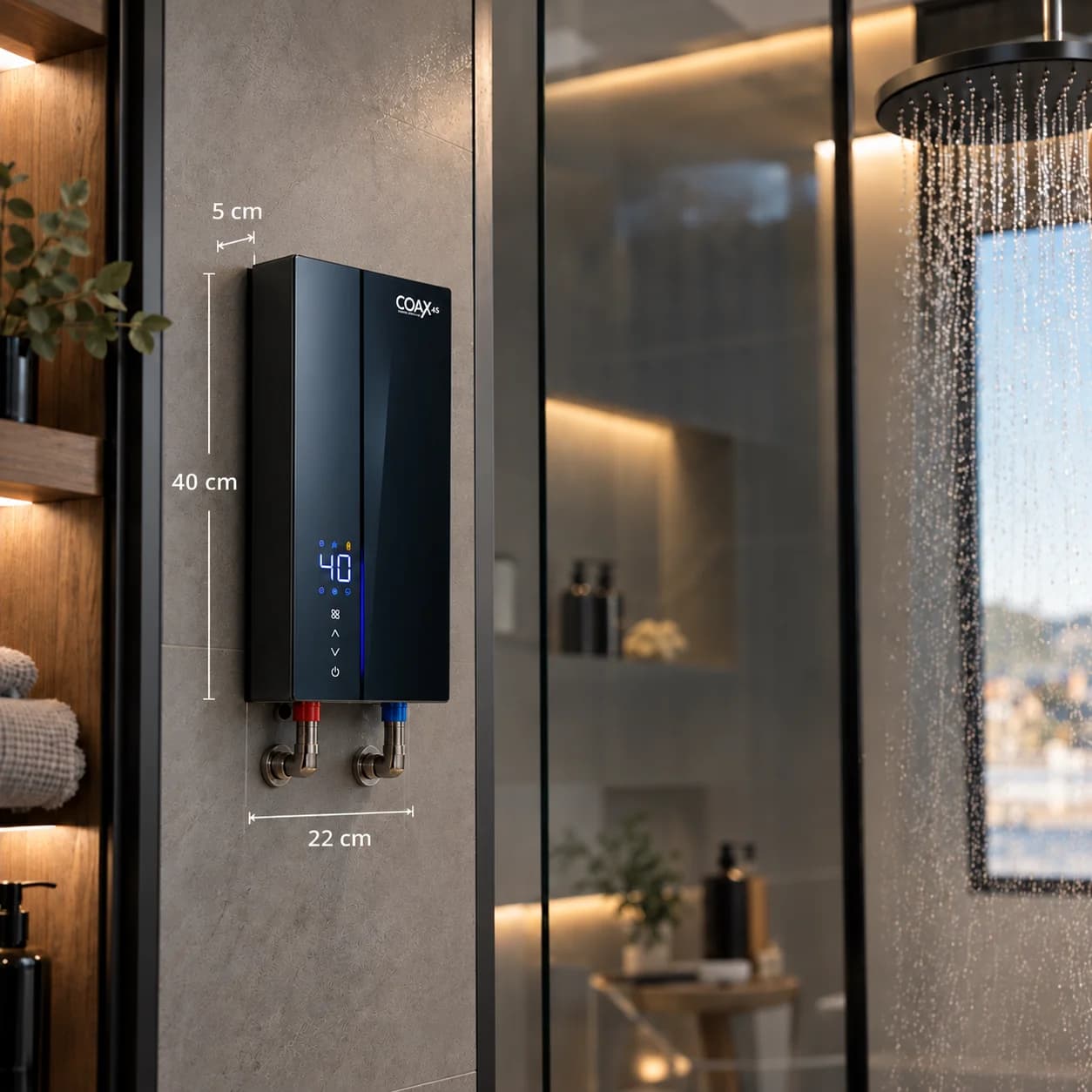
A tank heats water at lower power over a longer period and has a reserve ready when you open the tap. COAX has to deliver the heat there and then, so it draws more power while the water flows. In return, you avoid heat loss from a tank during the rest of the day. Savings come mainly from the losses you avoid. Heating the water itself takes roughly the same energy with either solution.
With COAX you can shower without a tank running empty, and the next person does not need to wait for more hot water. How long you can draw water is different from how many litres you can get per minute. A large rainfall shower or two showers at once needs more power than one water-saving shower. We help you choose a model for the flow you want, including when incoming water is cold in winter.
If your electricity supply is limited and you need a lot of hot water at once, a tank can still be a good choice. If space is tight, your old tank loses a lot of heat, or a tap is far from the tank, COAX is particularly worth considering. Include the cost of the whole installation when comparing. An electrician must assess whether you need a new circuit or other changes to the electrical system.
Point by point
Eighteen differences, from power and space to noise and frost.
| Point | Hot water tank | COAX |
|---|---|---|
| Type of solution | Storage in a tank, water kept hot around the clock | Direct flow-through heating, active only while you draw water |
| Electricity use | Continuous heat loss (standby loss) | No standby loss, uses electricity only in the minutes you draw hot water |
| Space required | Typically 60x60x120 cm, requiring a utility room or storage cupboard | 9x38x26 cm, can be fitted close to the outlet |
| Hygiene | Risk of bacterial growth in standing water | Water straight from the mains, with no storage in a tank |
| Capacity | Limited to the tank volume, runs out under heavy use | Hot water without reheating pauses; litres per minute depend on power and incoming temperature |
| Maintenance | Needs regular anode checks, cleaning and draining | Maintenance-free, with no moving parts |
| Service life | Insurers recommend replacement after 10–15 years, and leaks become more likely with age | Stainless steel heating chamber, with no anode |
| Installation | Needs a floor drain and a safety valve, often with long pipe runs | Simple installation, small unit, short pipes, no drain needed |
| System and pipework | Centralised, long pipes mean greater heat loss and more waiting | Decentralised, heat only where it is needed, almost no waiting |
| Frost protection (cabins) | Must be drained or kept in a heated room, with a risk of frost damage | Minimal frost risk, very small water volume, easy to drain |
| Environmental impact | Higher energy use and more water wasted while you wait | More environmentally friendly, low electricity consumption and less cold water wasted |
| Pressure and flow rate | Good pressure, but a limited water supply | Can supply several outlets when sized for their combined flow |
| Water-saving fixtures | Long waiting times make water-saving nozzles impractical, reduce comfort and waste more cold water | Hot water arrives quickly, so you can use efficient water-saving fixtures without reducing comfort |
| Energy loss in pipes | Large losses over long pipe runs from a central tank to the outlet | Almost no losses, short pipes and local heating |
| Scalability | One large unit that must be sized for peak demand | Modular: several small units can be installed at different outlets |
| Noise | Can produce clicking sounds and expansion noise as water heats | Near-silent operation, no large body of water being heated |
| Comfort at the tap | Waiting time at the tap, a burst of cold water before the hot arrives | Fast response time, fewer temperature swings |
| Safety | Risk of leaks or tank failure | No storage tank that can rust through or crack |
The saving depends on how much you use
You avoid the tank's heat loss. Your electricity price and hot water use determine how much that saves in kroner.